























Most people come to trauma treatment expecting the work to happen in their head. They expect to talk about what happened, gain some insight, and gradually feel better. What often surprises them is how much of the healing happens somewhere else entirely, in the chest, the shoulders, the gut, the breath, and the legs.
That is not a metaphor. It is neuroscience. And understanding what is actually happening when the body releases trauma can change how you experience the process and make you feel more supported in recovery.
What Does It Actually Mean for Trauma to Be Stored in the Body?
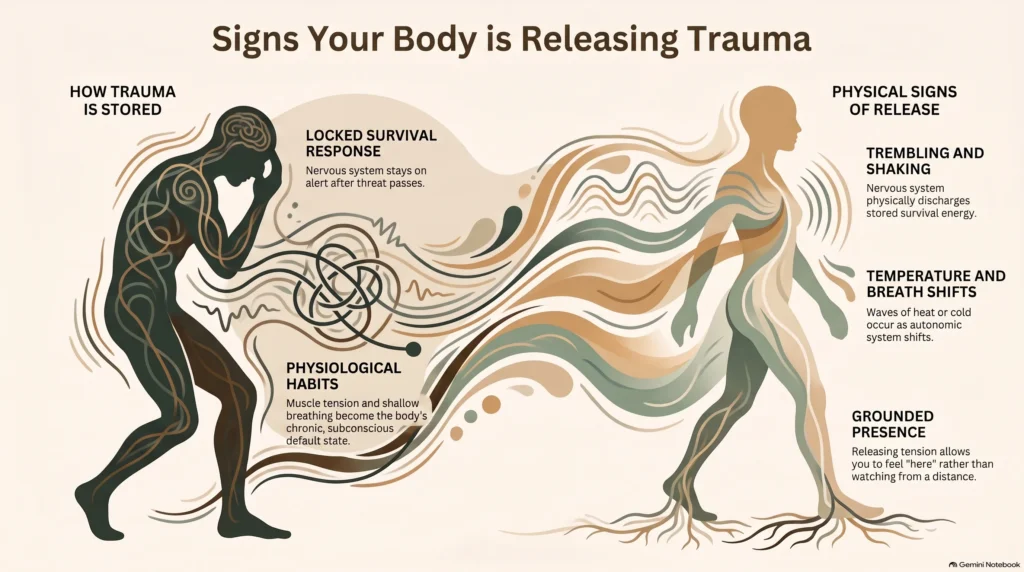
When something overwhelming happens, your nervous system activates a survival response. Heart rate spikes. Muscles tighten. Breathing shallows. The body mobilizes everything it has to get you through the threat.
When that threat passes but the response never fully completes — which is what happens in trauma — those physiological states do not just disappear. They get held in the body. The muscle tension stays. The shallow breathing becomes a habit. The nervous system stays on low-level alert even when there is nothing left to be afraid of [1].
What Are the Physical Signs That Trauma Is Being Released?
When the nervous system begins to process what it has been holding, the signals show up in the body before they show up in the mind. Here is what that can look like:
Spontaneous shaking or trembling. During or after a therapy session, you might notice your hands trembling slightly or a shaky sensation moving through your torso. This is the nervous system discharging stored survival energy [2].
Waves of heat or cold. Sudden temperature changes, warmth spreading through the chest, or a chill moving through the limbs are the autonomic nervous system shifting out of a chronic stress pattern.
Unexpected emotions. Tears that arrive without a clear narrative. A wave of grief or relief that seems to come from nowhere. One of the hallmarks of body-based trauma work is that emotion can surface through the body before the mind catches up.
Changes in breathing. Trauma almost universally shows up in the breath, specifically in the habit of breathing shallowly, holding the breath, or not fully exhaling. As trauma releases, the breath deepens and slows [3].
Fatigue that feels different from exhaustion. Processing stored trauma takes real physiological energy. After a meaningful session, many people feel genuinely tired in a way that is different from stress-related exhaustion.
Feeling more present or more grounded. The opposite of trauma is not happiness. It is presence. As the nervous system releases what it has been bracing against, many people describe simply feeling more here, more in their body, less like they are watching their life from a slight distance.
Can EMDR and Accelerated Resolution Therapy Help Release Trauma?
Yes, both EMDR and Accelerated Resolution Therapy, or ART, work by targeting the way traumatic memories are stored and processed in the brain rather than simply talking about them.
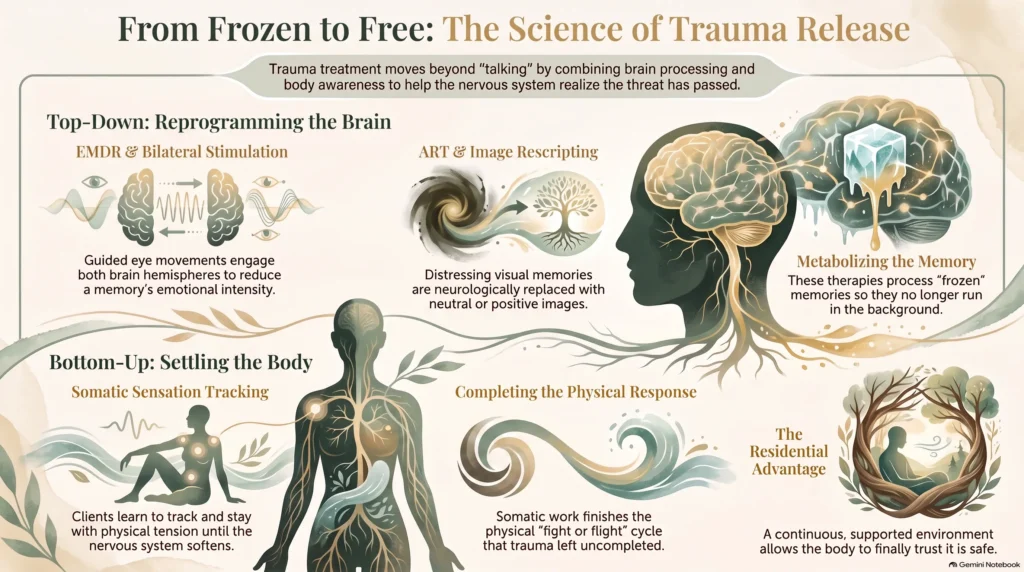
EMDR uses bilateral stimulation, typically guided eye movements, to engage both hemispheres of the brain simultaneously while the person holds a traumatic memory in mind. This allows the brain to process the memory in a way that gradually reduces its emotional intensity and integrates it into the broader story of a person’s life rather than keeping it frozen in place [1].
ART builds on a similar framework but adds a specific component of image rescripting, allowing clients to replace distressing visual memories with more neutral or positive images at a neurological level. Many clients describe the memory feeling distant or flat after ART processing, where it previously felt immediate and overwhelming.
Both therapies produce real, measurable changes in how the nervous system responds to traumatic memories. They are not about suppressing the memory, they are about metabolizing it so it no longer runs in the background, shaping behavior and emotion in ways the person cannot fully see or control.
How Does Somatic Therapy Complement These Approaches?
EMDR and ART work primarily top-down, engaging the brain’s processing systems to resolve stored trauma. Somatic therapy works primarily bottom-up, starting with the body’s sensations and using them as the pathway into healing [2].
A client might use EMDR to process a specific traumatic memory and then work with a somatic therapist to notice and complete the physical response that the memory had been activating for years.
Through somatic work, clients learn to track sensations in real time, to notice the tension and stay with it long enough for the nervous system to realize the threat has passed. Over time, the automatic response softens and eventually stops.
Trauma-Focused Treatment at Maple Mountain Recovery
At Maple Mountain Recovery in Mapleton, Utah, our trauma treatment model integrates EMDR, Accelerated Resolution Therapy, Internal Family Systems, and somatic therapy into a cohesive clinical program that addresses trauma at every level.
Our residential program provides the time and safety that deep trauma work requires. Clients do not have to rush back to the demands of daily life between sessions. The healing happens in one continuous, supported environment, which is often what allows the body to finally trust that it is safe enough to let go.
If you have been carrying trauma and are ready to do the work of release, we are here to support you.

Sources:
[1] Payne, P., Levine, P. A., & Crane-Godreau, M. A. (2015). Somatic experiencing: Using interoception and proprioception as core elements of trauma therapy. Frontiers in Psychology, 6, 93.
[2] Kuhfuss, M., et al. (2021). Somatic experiencing: Effectiveness and key factors of a body-oriented trauma therapy. European Journal of Psychotraumatology, 12(1), 1929023.
[3] Moreno-Alcazar, A., et al. (2025). The acceptability of somatic therapy for PTSD among patients at an urban safety net primary care clinic. PMC, National Library of Medicine.