























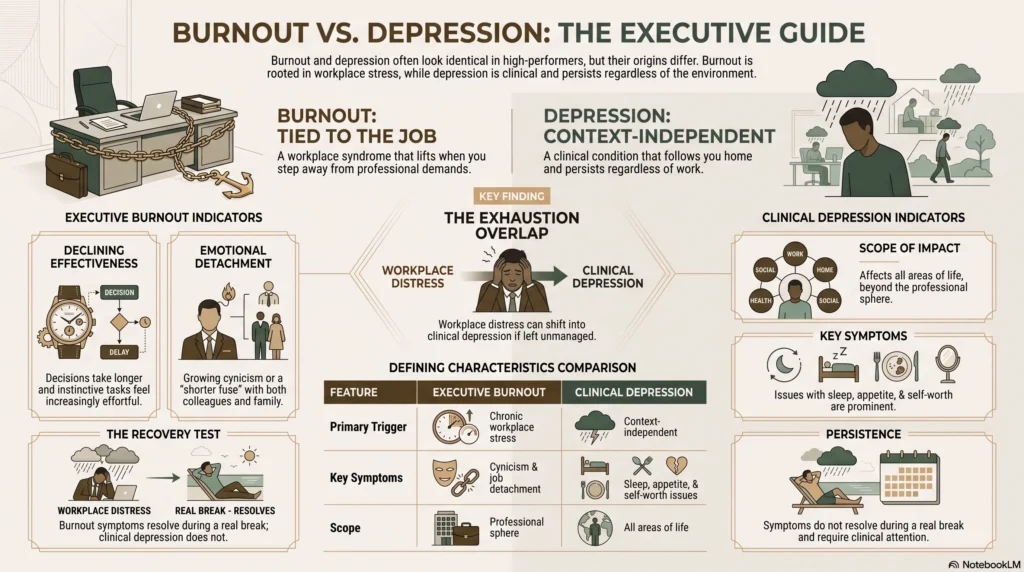
Burnout and depression can look identical from the outside, but they are not the same, and treating one as the other is why so many executives stay stuck. The key difference: burnout lifts when you step away from work. Depression follows you home.
For executives, the stakes of getting this wrong are high, since the two conditions call for different responses and rarely resolve with a long weekend or a delegated task list.
What Is the Difference Between Burnout and Depression?
Burnout is defined by the World Health Organization as a syndrome resulting from chronic workplace stress that has not been successfully managed, and it shows up in three specific ways: exhaustion, growing cynicism or mental distance from the job, and a declining sense of professional effectiveness [1].
Depression, by contrast, is a clinical condition marked by a depressed mood or loss of interest that persists for at least two weeks and touches sleep, appetite, energy, concentration, and self-worth, regardless of what is happening at work [2].
In theory, burnout is tied to the job. Depression is not tied to any one context.
Why Do Burnout and Depression Overlap So Much at the Top?
Recent research has pushed back on the idea that burnout and depression are cleanly separate conditions.
A 2021 review found that exhaustion, the core symptom of burnout, tracks more closely with depressive symptoms than with the other two burnout dimensions, and the researchers argue that job-related distress may be better understood within the established framework of depression rather than as an entirely separate construct [3].
For an executive, this means the exhaustion that started as a demanding quarter can, without intervention, shift into something that no longer lifts once the quarter ends.
What Does Burnout Look Like in an Executive Role?
Burnout in leadership rarely announces itself as a crisis. Meetings that once energized you now feel draining, decisions that used to take minutes stretch into hours, and the parts of the job you were genuinely good at start to feel effortful rather than instinctive.
It is common for high performers to push through this stage by working harder, since the instinct to solve problems personally is often what got them into leadership in the first place.
That instinct, unfortunately, tends to make burnout worse rather than better, since it adds more hours to a schedule that is already the source of the problem rather than subtracting from it.
Burnout in executives tends to show up as:
- Relief and recovery when you finally step away, on vacation or a real break
- Exhaustion that is specifically tied to work and the demands of the role
- Cynicism or detachment toward work you used to find meaningful
- A drop in performance or effectiveness, despite the same or greater effort
- Irritability and a shorter fuse with colleagues, family, or both
- Dreading work or feeling depleted at the very thought of it
What Does Depression Look Like in High-Performing Leaders?
Depression in executives often hides behind competence. Someone can still close deals, run board meetings, and hit targets while privately falling apart. Common signs include:
- Persistent low mood that lingers for weeks, not just a bad day here and there
- Sleep disruption, either difficulty sleeping or sleeping and still waking exhausted
- Chronic fatigue that rest does not fix
- Loss of interest in things that once mattered, including relationships and pursuits outside of work
- Difficulty concentrating or making decisions that used to come easily
- A creeping sense of emptiness or worthlessness, even in the face of external success
- Withdrawing from family, friends, and anything that is not work
Because executives are trained to compartmentalize and perform under pressure, depression can go unnoticed by colleagues and even by executives themselves for months. It gets mistaken for a rough patch rather than recognized for what it is [4].
Why Do Executives Wait So Long to Ask for Help?
The barriers are rarely about access. They are about identity. Many executives equate asking for help with admitting weakness and worry that any sign of struggle will shake confidence in their leadership or tarnish their professional reputation [4].
Confidentiality concerns add another layer, particularly for public-facing leaders or anyone whose calendar is tracked by an assistant, a board, or a company they cannot simply disappear from for a few weeks.
The result is that many executives wait until the exhaustion or low mood has become severe before they take it seriously, which makes recovery slower and harder than it needs to be. By the time most leaders reach out, they have usually been managing symptoms quietly for months, sometimes years, convinced that admitting the problem out loud would cost them more than staying silent ever did.

Addiction & Mental Health Treatment for Executives: Recover in the Privacy of Utah’s Mountains
Maple Mountain works with executives who need more than a weekend off but cannot simply vanish from their responsibilities for a month either. Programming is built around flexibility, with options that allow for continued, limited work engagement where appropriate, rather than an all-or-nothing leave of absence.
The facility sits in the mountains of Utah, offering genuine physical distance from the office for executives who travel from out of state and need space specifically because their daily environment is part of the problem. Privacy is treated as a clinical necessity, not an amenity, and the admissions team works directly with employer-sponsored insurance plans without disclosing diagnosis or treatment details to an employer, so that getting care does not put a career at risk.
For executives trying to figure out whether what they are feeling is burnout, depression, or both, we can provide an honest, confidential assessment from people who understand what leadership actually demands.
Getting an accurate read is the first real step toward feeling steady again, at work and everywhere else. Contact our admissions team today for a confidential conversation about what recovery could look like for you.

Sources
[1] World Health Organization. Burn-out an “occupational phenomenon”: International Classification of Diseases. who.int.
[2] National Institute of Mental Health. Major Depression. nimh.nih.gov.
[3] Bianchi, R. et al. (2021). From Burnout to Occupational Depression: Recent Developments in Research on Job-Related Distress and Occupational Health. Frontiers in Public Health. frontiersin.org.
[4] McLean Hospital. The Silent Strain at the Top: Mental Health Among Executive Leadership. mcleanhospital.org.